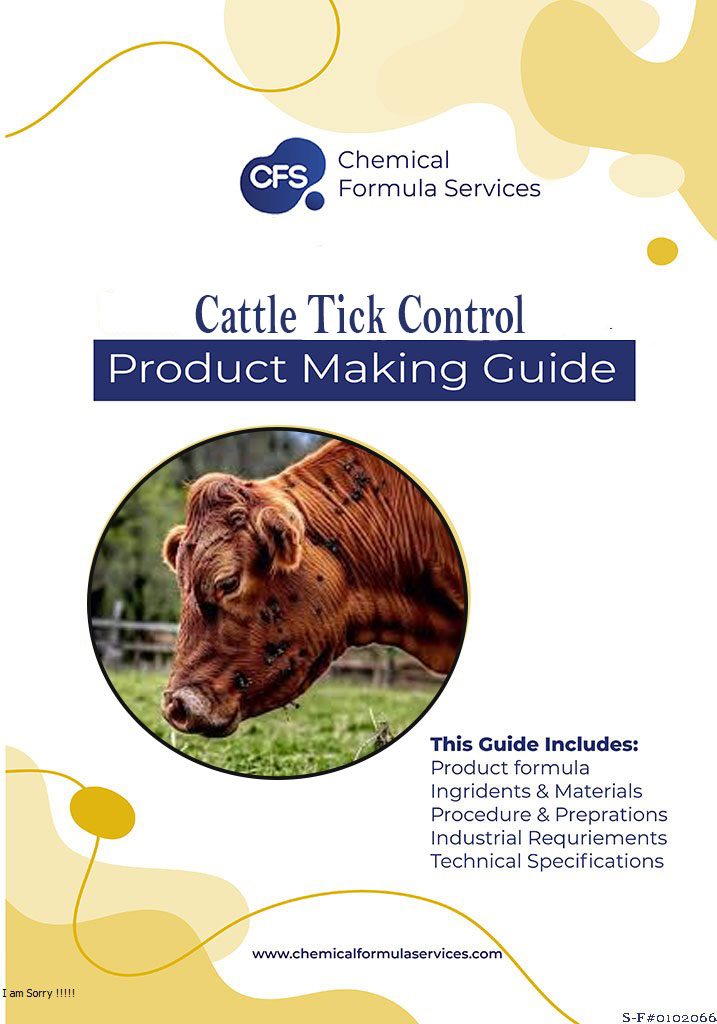
Cattle Tick Control Formulation & Manufacturing Handbook
$ 99
Description
Cattle Tick Control Formulation & Manufacturing Handbook is a veterinary topical products designed to prevent and treat tick infestations in livestock. These formulations are applied externally and act either through direct contact toxicity, residual surface action, or repellent mechanisms. The primary target organisms include hard ticks of the genus Rhipicephalus (formerly Boophilus), which are responsible for economic losses in cattle production systems due to blood loss, hide damage, reduced weight gain, and transmission of tick-borne diseases.
TABLE OF CONTENTS
SECTION 1 — PRODUCT OVERVIEW
1.1 Product Description
1.2 Industrial Applications
1.3 Performance Expectations
SECTION 2 — RAW MATERIALS SUMMARY
2.1 Functional Raw Material Categories
2.2 Key Raw Materials & Their Roles
2.3 Water Quality & Utility Requirements
SECTION 3 — MACHINERY & EQUIPMENT
3.1 Recommended Manufacturing Equipment
3.2 Mixing & Agitation Requirements
3.3 Instrumentation (pH, Viscosity, Temperature Monitoring)
FORMULATION SECTION
FORMULATION 1 — Veterinary Grade Tick Grease (Standard Efficacy)
4.1.1 Application Scope
4.1.2 Final Raw Material Formulation Table
4.1.3 Step-by-Step Manufacturing Process
4.1.4 Key Process Control Points
4.1.5 Finished Product Properties
4.1.6 Quality Control Parameters
4.1.7 Standard Testing Methods
4.1.8 Troubleshooting Guide
4.1.9 Packaging, Storage & Shelf Life
4.1.10 Process Safety Notes
FORMULATION 2 — Premium Synthetic Tick Grease (High Efficacy System)
4.2.1 Application Scope
4.2.2 Final Raw Material Formulation Table
4.2.3 Step-by-Step Manufacturing Process
4.2.4 Key Process Control Points
4.2.5 Finished Product Properties
4.2.6 Quality Control Parameters
4.2.7 Standard Testing Methods
4.2.8 Troubleshooting Guide
4.2.9 Packaging, Storage & Shelf Life
4.2.10 Process Safety Notes
FORMULATION 3 — Liquid Tick Dip Concentrate (Acaricide-Based System)
4.3.1 Application Scope
4.3.2 Final Raw Material Formulation Table
4.3.3 Step-by-Step Manufacturing Process
4.3.4 Key Process Control Points
4.3.5 Finished Product Properties
4.3.6 Quality Control Parameters
4.3.7 Standard Testing Methods
4.3.8 Troubleshooting Guide
4.3.9 Packaging, Storage & Shelf Life
4.3.10 Process Safety Notes
FORMULATION 4 — Organic Veterinary-Grade Pour-On / Spray System
4.4.1 Application Scope
4.4.2 Final Raw Material Formulation Table
4.4.3 Step-by-Step Manufacturing Process
4.4.4 Key Process Control Points
4.4.5 Finished Product Properties
4.4.6 Quality Control Parameters
4.4.7 Standard Testing Methods
4.4.8 Troubleshooting Guide
4.4.9 Packaging, Storage & Shelf Life
4.4.10 Process Safety Notes
FORMULATION 5— Pyrethroid-Based Spray Concentrate
4.5.1 Application Scope
4.5.2 Final Raw Material Formulation Table
4.5.3 Step-by-Step Manufacturing Process
4.5.4 Key Process Control Points
4.5.5 Finished Product Properties
4.5.6 Quality Control Parameters
4.5.7 Standard Testing Methods
4.5.8 Troubleshooting Guide
4.5.9 Packaging, Storage & Shelf Life
4.5.10 Process Safety Notes
SECTION 5 — QUALITY CONTROL & TESTING (COMMON)
5.1 In-Process Quality Checks
5.2 Finished Product Acceptance Criteria
5.3 Batch-to-Batch Consistency Control
5.4 Stability & Storage Testing Protocols
SECTION 6 — TROUBLESHOOTING, SAFETY & HANDLING
6.1 Common Manufacturing Problems & Solutions
6.2 Chemical Handling & PPE Requirements
6.3 Storage Conditions & Environmental Controls
6.4 Spill Management & Emergency Measures
These formulations are designed for veterinary external use only and are not intended for systemic administration. Product selection depends on infestation severity, farm infrastructure, resistance management strategy, and regulatory requirements in the target market.