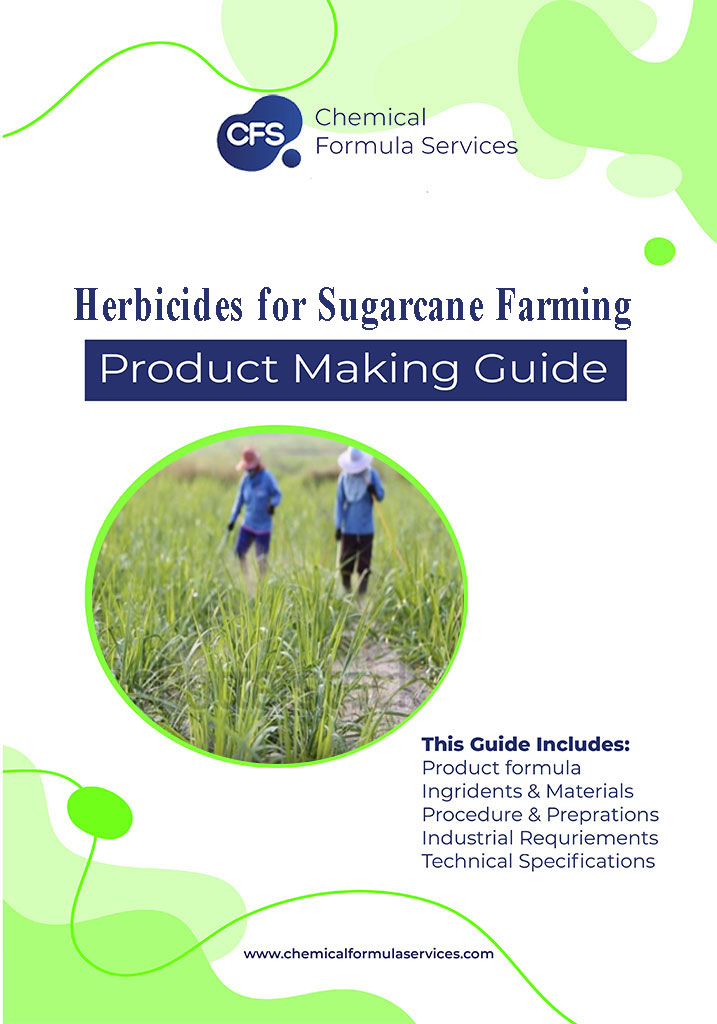
Herbicides for Sugarcane Farming
$ 99
Description
Herbicides for Sugarcane Farming
Formula Guide Content
CHAPTER 1 — Introduction to Weed Management in Sugarcane
1.1 Importance of weed control in sugarcane
1.2 Economic losses due to weeds
1.3 Critical weed competition stages (0–120 days)
1.4 Limitations of mechanical & manual weeding
1.5 Role of chemical weed control
1.6 Scope of herbicide formulations in sugarcane
CHAPTER 2 — Weed Flora in Sugarcane Fields
2.1 Classification of weeds
- Grassy weeds
- Broadleaf weeds
- Sedges
2.2 Major grassy weeds
2.3 Major broadleaf weeds
2.4 Major sedges
2.5 Seasonal weed dynamics (rainy / irrigated)
2.6 Weed resistance trends
CHAPTER 3 — Herbicide Application Timings in Sugarcane
3.1 Pre-plant herbicides
3.2 Pre-emergence herbicides
3.3 Early post-emergence herbicides
3.4 Post-emergence herbicides
3.5 Directed spray vs blanket spray
3.6 Ratoon crop weed management
CHAPTER 4 — Herbicide Chemistry Used in Sugarcane
4.1 Triazines
4.2 Chloroacetamides
4.3 Sulfonylureas
4.4 Phenoxy herbicides
4.5 Bipyridylium compounds
4.6 Synthetic auxins
4.7 Non-selective herbicides
4.8 Herbicide mode of action (MOA)
CHAPTER 5 — Pre-Emergence Herbicide Formulations
(Commercial Manufacturing Focus)
5.1 Atrazine SC / WP formulations
5.2 Metribuzin WP / WG formulations
5.3 Pendimethalin EC / CS formulations
5.4 Acetochlor EC formulations
5.5 Combination pre-emergence products
Each formulation includes:
- Formula table (% w/w, CAS, function)
- Manufacturing process
- QC parameters
- Stability tests
- Troubleshooting
CHAPTER 6 — Post-Emergence Herbicide Formulations
6.1 2,4-D Amine SL formulations
6.2 Metsulfuron-methyl WG formulations
6.3 Halosulfuron SC / WG formulations
6.4 Glyphosate SL (directed spray)
6.5 Paraquat SL (restricted use note)
CHAPTER 7 — Selective vs Non-Selective Herbicides
7.1 Selectivity principles in sugarcane
7.2 Crop tolerance mechanisms
7.3 Safe use of non-selective herbicides
7.4 Drift management
7.5 Shielded spraying techniques
CHAPTER 8 — Combination & Tank-Mix Herbicide Products
8.1 Atrazine + Pendimethalin
8.2 Atrazine + Metribuzin
8.3 Halosulfuron + 2,4-D
8.4 Compatibility testing procedures
8.5 Physical & chemical incompatibilities
CHAPTER 9 — Adjuvants, Surfactants & Wetting Agents
9.1 Role of adjuvants in sugarcane
9.2 Non-ionic surfactants (NIS)
9.3 Oil-based adjuvants (MSO, COC)
9.4 Sticker-spreaders
9.5 pH buffers & water conditioners
9.6 Adjuvant formulation examples
CHAPTER 10 — Manufacturing Process & Plant Requirements
10.1 Raw material selection
10.2 Batch manufacturing flow
10.3 EC, SC, SL, WG, WP equipment
10.4 Filtration & milling systems
10.5 Quality control checkpoints
10.6 Production scale-up issues
CHAPTER 11 — Quality Control & Testing
11.1 Active ingredient assay
11.2 Emulsion stability
11.3 Suspensibility
11.4 pH & viscosity
11.5 Particle size analysis
11.6 Cold & heat stability
11.7 Shelf-life estimation
CHAPTER 12 — Crop Safety & Phytotoxicity Management
12.1 Common phytotoxic symptoms
12.2 Dose optimization
12.3 Spray timing effects
12.4 Soil type influence
12.5 Herbicide carryover issues
12.6 Ratoon crop safety
CHAPTER 13 — Application Technology
13.1 Spray equipment types
13.2 Nozzle selection
13.3 Spray volume optimization
13.4 Calibration procedures
13.5 Drift reduction techniques
CHAPTER 14 — Environmental & Resistance Management
14.1 Herbicide resistance development
14.2 MOA rotation strategies
14.3 Environmental fate of herbicides
14.4 Leaching & runoff control
14.5 Safe disposal practices
CHAPTER 15 — Packaging, Labeling & Storage
15.1 Packaging material selection
15.2 HDPE, fluorinated containers
15.3 Label content requirements
15.4 Storage conditions
15.5 Transport safety
CHAPTER 16 — Regulatory & Compliance Overview
16.1 Registration requirements (general)
16.2 FAO & WHO guidelines
16.3 Restricted & banned actives
16.4 Export documentation basics
CHAPTER 17 — Costing & Commercial Viability
17.1 Raw material costing
17.2 Manufacturing cost breakdown
17.3 Margin analysis
17.4 Bulk vs retail economics
17.5 Private label strategy
CHAPTER 18 — Troubleshooting Guide
18.1 Poor weed control
18.2 Crop injury issues
18.3 Emulsion failure
18.4 Sedimentation problems
18.5 Storage instability
CHAPTER 19 — Case Studies & Field Programs
19.1 Plant cane weed program
19.2 Ratoon crop weed program
19.3 Rainfed vs irrigated conditions
19.4 Integrated weed management (IWM)
CHAPTER 20 — FAQs
- Best pre-emergence herbicide for sugarcane
- Safe post-emergence options
- Tank-mix mistakes
- Ratoon crop solutions
- Common formulation failures
APPENDICES
- Common weed identification charts
B. Herbicide dosage reference table
C. Spray calendar
D. Safety data symbols
E. Glossary of formulation terms
This CFS Handbook, “Herbicides for Sugarcane Farming,” has been written to serve as a comprehensive, practical, and industry-focused guide for:
- Agrochemical manufacturers and formulators
- Technical consultants and agronomists
- Private-label and export-oriented companies
- Advanced growers and plantation managers
Unlike general agronomy texts, this book places strong emphasis on commercial-grade herbicide formulations, including EC, SC, SL, WG, WP, CS, and combination products. Each topic is approached from a real-world manufacturing and field-use perspective, covering formulation logic, processing steps, quality control, troubleshooting, crop safety, and economic viability.