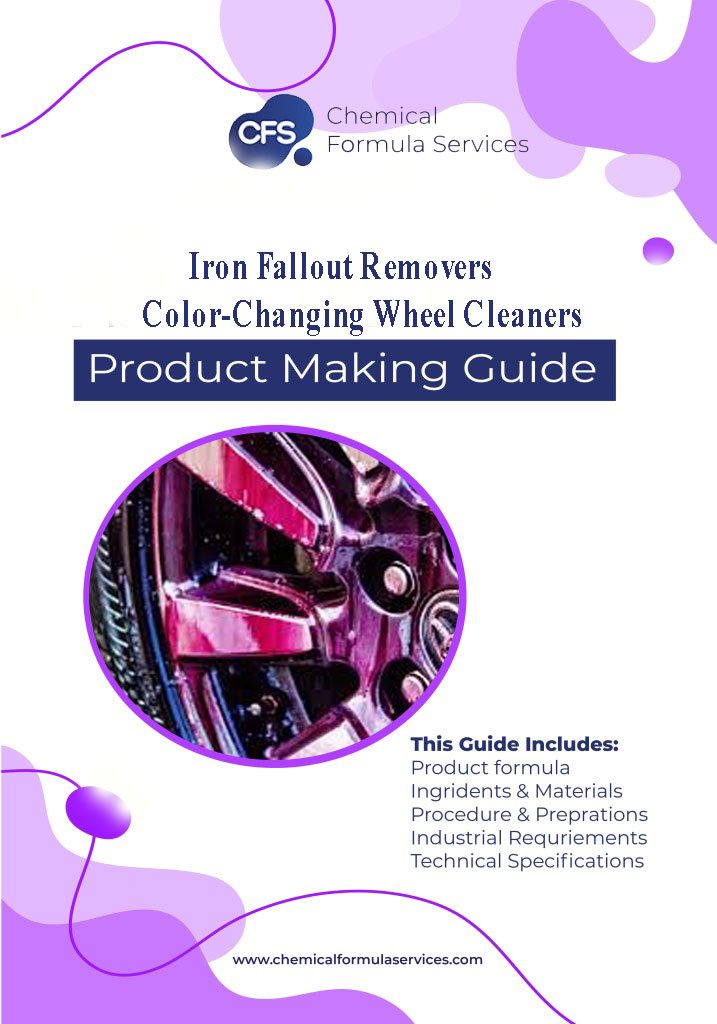
Iron Fallout Removers & Color-Changing Wheel Cleaners Formulations Guide
$ 149
Description
Iron Fallout Removers & Color-Changing Wheel Cleaners Formulations Guide Guide
This advanced technical handbook delivers a complete industrial framework for developing high-performance iron fallout removers and color-changing wheel cleaners. Designed for professional formulators, private label manufacturers, and automotive chemical producers, it combines deep reaction chemistry, raw material technology, manufacturing scale-up engineering, quality control systems, and ten fully structured commercial formulations. Each formula follows a locked industrial format to ensure clarity, repeatability, and production-ready implementation.
Inside The Book Iron Fallout Removers & Color-Changing Wheel Cleaners Formulations Guide
SECTION 1 — FUNDAMENTAL CHEMISTRY OF IRON REACTIVE SYSTEMS
- Introduction to Iron Fallout & Brake Dust Contamination
- Composition and Behavior of Ferrous Brake Dust Particles
- Mechanism of Iron–Thioglycolate Complex Formation
- pH Influence on Reactivity and Stability
- Surface Compatibility: Aluminum, Clear Coat & Chrome
- Odor Chemistry in Sulfur-Based Systems
- Corrosion Mechanisms & Inhibition Strategies
- Chelation and Metal Ion Control
SECTION 2 — RAW MATERIAL TECHNOLOGY
- Iron Reactive Agents
9.1 Thioglycolic Acid
9.2 Sodium Thioglycolate
9.3 Mercaptoacetate Alternatives - Surfactant Systems for Wheel & Iron Removal
10.1 Anionic Systems
10.2 Nonionic Alcohol Ethoxylates
10.3 Amphoteric Boosters
10.4 Foam Modifiers - Chelating Agents & Builders
- Corrosion Inhibitors
- Preservatives & Antioxidants
- Dye Systems vs Reaction Color
- Fragrance Stabilization in Reactive Formulas
- Water Quality & Deionization Requirements
PROFESSIONAL FORMULATION SERIES
FORMULATION 1 — Standard pH Neutral Iron Fallout Remover
FORMULATION 2 — High-Performance Professional Iron Remover
FORMULATION 3 — Low-Odor Iron Remover System
FORMULATION 4 — Acid-Assisted Iron Remover
FORMULATION 5 — Alkaline Heavy-Duty Wheel & Iron Cleaner
FORMULATION 6 — Foaming Iron Remover (Snow Foam Compatible)
FORMULATION 7 — High-Concentration Dilutable Iron Remover
FORMULATION 8 — Gel-Type High Cling Iron Remover
FORMULATION 9 — Premium All-in-One Wheel & Iron Cleaner
FORMULATION 10 — Cost-Optimized Commercial Grade Formula
MANUFACTURING & SCALE-UP ENGINEERING
- Equipment Selection & Tank Material Compatibility
- Mixing Sequence Optimization
- Scale-Up from Lab to Production
- Temperature Control & Oxidation Prevention
- Filtration & Filling Procedures
- Odor Control in Production Facilities
QUALITY CONTROL & PERFORMANCE TESTING
- Raw Material Quality Verification
- In-Process Batch Monitoring
- Final Product Acceptance Criteria
- Accelerated Aging & Shelf-Life Testing
- Freeze–Thaw Stability Testing
- Iron Reaction Time Testing Protocol
- Corrosion Coupon Testing
- Field Performance Evaluation
TROUBLESHOOTING & TECHNICAL PROBLEM SOLVING
- pH Drift During Storage
- Weak Color Reaction
- Excessive Odor Issues
- Surface Staining Complaints
- Phase Separation or Haze Formation
- Reduced Shelf Stability
COMMERCIALIZATION & REGULATORY FRAMEWORK
- Safety Data Sheet (SDS) Preparation Guidelines
- Labeling Requirements & Hazard Communication
- International Regulatory Overview (EU / US / Global)
- Benchmarking Against Major Market Brands
- Cost Structure & Profit Modeling
- Private Label & OEM Manufacturing Strategy
APPENDICES
Appendix A — Standard Test Methods Reference
Appendix B — Sample Batch Record Template
Appendix C — Raw Material Specification Sheet Template
Appendix D — Stability Testing Log Template
Appendix E — Equipment Sizing Guide
Whether you are launching a new detailing product line or upgrading an existing range, this guide provides the scientific foundation, process control discipline, and regulatory insight required to build stable, competitive, and commercially successful iron-reactive cleaning systems.
Develop smarter. Manufacture stronger. Compete professionally — with CFS.