Organic Angrochemicals Formulation
$ 99
Description
Organic Agrochemicals Formulation is a professional, industry-focused master guide designed for manufacturers, formulators, entrepreneurs, and agribusiness professionals entering or expanding in the organic crop protection market.
The book covers the complete lifecycle of organic agrochemical development — from raw material selection and formulation science to manufacturing setup, quality control, certification compatibility, application strategy, costing, branding, and pricing. It includes 30 fully detailed, commercially scalable formulations across organic herbicides, bio-insecticides, and bio-fungicides, written in a structured, manufacturing-ready format.
Unlike farming guides, this book focuses on how to make organic agrochemicals professionally, making it suitable for industrial training, product development, and business planning.
Organic Agrochemicals
Organic agrochemicals are crop protection products derived from natural, plant-based, mineral, or biological sources that align with the principles of organic and sustainable agriculture. Unlike synthetic agrochemicals, organic inputs are designed to:
- Minimize environmental impact
• Preserve soil biology and microbial life
• Reduce residue risks on food crops
• Support long-term sustainable agriculture
The global shift toward residue-free food, organic certification, and eco-labeling has driven rapid growth in demand for organic crop protection solutions.
This book provides a complete industrial roadmap for the professional formulation, manufacturing, quality control, and commercialization of organic agrochemicals.
Scope of Organic Crop Protection Products
- Organic Herbicides
- Contact weed killers
• Natural acids and plant oils
• Soap and fatty acid salts
• Pre-emergent bio-herbicides
- Bio-Insecticides
- Botanical extracts
• Oils and fatty acids
• Microbial products (overview)
- Bio-Fungicides
- Plant-based antifungal extracts
• Mineral protectants
• Biological suppressants
Each category follows distinct formulation principles that differ fundamentally from synthetic agrochemical chemistry.
What Makes an Agrochemical “Organic”
- Uses naturally derived raw materials
• Avoids synthetic toxic solvents
• Is biodegradable
• Is compatible with organic certification systems
• Leaves minimal or no harmful residues
This chapter explains:
• Key differences between organic and synthetic agrochemicals
• Allowed versus prohibited inputs
• Common misconceptions surrounding “natural” products
Raw Materials Used in Organic Agrochemicals
- Organic Active Ingredients
Organic Herbicide Actives
- Pelargonic acid (nonanoic acid)
• Acetic acid
• Citric acid
• Caprylic and capric acids
• Potassium fatty acid salts
• D-limonene (orange oil)
• Pine oil
• Clove oil
• Cinnamon oil
• Eugenol
• Thyme oil
• Garlic oil
• Corn gluten meal
Insecticide Actives
- Neem oil
• Azadirachtin extracts
• Karanja oil
• Pyrethrum extract
• Essential oil blends
Fungicide Actives
- Copper alternatives (limited use)
• Plant polyphenols
• Sulfur-compatible blends
• Botanical antifungal extracts
- Organic-Compatible Additives
- Plant-based surfactants
• Natural emulsifiers
• Bio-solvents (ethanol, esters)
• Natural stabilizers (xanthan gum, guar gum, cellulose gum)
• Natural preservatives
• Chelators (citric-based)
• pH buffers
• Natural fragrance and color
Basics Organic Formulation Science
- Emulsification without harsh synthetic solvents
• Stabilization of volatile essential oils
• Precise control of pH (critical for stability and efficacy)
• Prevention of phase separation
• Enhancement of leaf penetration using natural mechanisms
Organic formulations require precision and balance, not unnecessary complexity.
Organic Herbicide Formulation Technologies
- EC-type (natural solvent-based systems)
• EW / ME (emulsion-in-water systems)
• SL (acid and salt solutions)
• SC (mineral or oil suspensions)
• WP / WG (wettable powders and granules)
• Thickened gels and ready-to-use (RTU) sprays
Special emphasis is placed on essential oil stabilization and safety.
Bio-Insecticide Formulation Technologies
- Oil-based insecticide systems
• Stabilization of botanical extracts
• UV protection of sensitive actives
• Emulsification of neem and karanja oils
• Shelf-life improvement without synthetic preservatives
Organic Bio-Fungicide Formulation Technologies
- Botanical antifungal blends
• Mineral-based protectants
• Surface-acting versus systemic-like behavior
• pH-dependent stability of fungicidal actives
Modes of Action in Organic Agrochemicals
- Contact tissue desiccation
• Cell membrane disruption
• Acid burn mechanisms
• Repellency and feeding deterrence
• Spore germination inhibition
• Dehydration and suffocation
Differences between fast-burn and slow-action systems are clearly explained.
Manufacturing Setup for Organic Agrochemicals
- SS-316 stainless steel mixing tanks
• Low-shear and high-shear mixers
• Temperature-controlled processing
• pH-controlled systems
• Hygienic plant design and layout
Equipment & Utilities
- Stainless steel tanks
• High-shear emulsifiers
• Powder blenders
• Filtration units
• Filling and capping lines
• Quality control laboratory instruments
Organic plants emphasize cleanability, hygiene, and contamination prevention.
Quality Control for Organic Products
- pH stability
• Emulsion or suspension stability
• Viscosity control
• Active content verification
• Microbial contamination control
• Accelerated shelf-life testing
Organic products require tighter quality control than synthetic formulations.
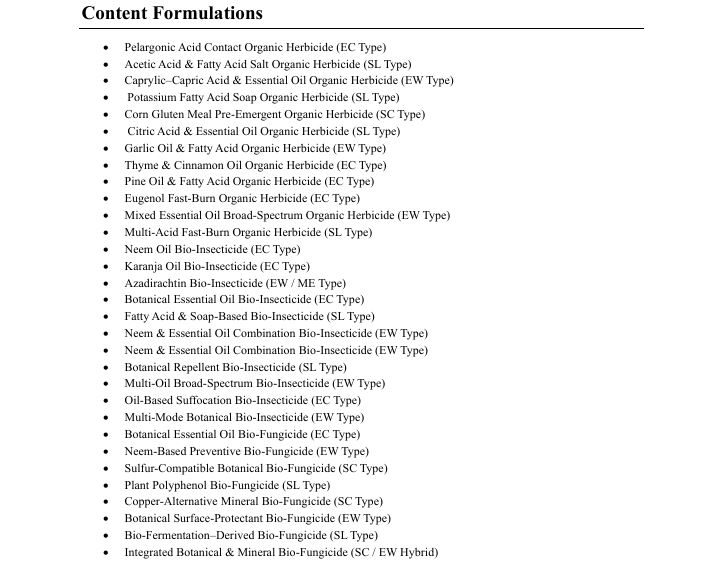
30 Fully Detailed Organic Formulations
Each formulation includes:
- Raw material list
• Function of each ingredient
• Typical percentage ranges
• Example formulation
• Step-by-step processing
• Quality control parameters
• Packaging and shelf-life guidance
Formulation Categories
- 12 Organic Herbicides
• 10 Bio-Insecticides
• 8 Bio-Fungicides
(All formulations are non-restricted, non-toxic, and commercially scalable.)
Application Guidelines for Organic Products
- Application rate per acre / hectare
• Mixing instructions
• Spray volume requirements
• Nozzle selection
• Timing and sunlight effects
• Rainfastness expectations
• Repeat application strategies
Organic systems rely on strategy and consistency, not single sprays.
Safety & Handling (Organic Context)
- Low-hazard handling practices
• Child-safe packaging considerations
• Food-crop safety guidelines
• Worker exposure minimization
Organic does not mean careless — safety still matters.
Organic Certification Compatibility (Overview)
- Certification compatibility concepts
• Ingredient traceability requirements
• Label wording rules
• Export market expectations
(No regulatory claims — educational guidance only.)
Packaging for Organic Agrochemicals
- HDPE and bio-plastic containers
• Light protection for oil-based products
• Eco-friendly labeling
• Small pack formats for home and garden use
Shelf-Life & Stability Management
- Oxidation prevention
• Temperature sensitivity
• Volatility control
• Natural preservative systems
Costing & Profit Analysis
- Raw material costing
• Manufacturing cost per liter / kilogram
• Packaging cost analysis
• Distributor margins
• Premium pricing logic for organic products
Branding & Market Positioning
- “Organic-safe” branding principles
• Eco-trust building
• Educating farmers and gardeners
• Differentiation from synthetic products
Pricing Strategy for Organic Products
- Premium pricing justification
• Home-garden versus farm pricing
• Bulk packs versus ready-to-use (RTU) packs
Building an Organic Product Portfolio
- 2 organic herbicides
• 2 bio-insecticides
• 1 bio-fungicide
• 1 multi-purpose botanical spray
Common Organic Formulation Problems & Solutions
- Phase separation
• Oil oxidation
• Odor complaints
• Reduced efficacy complaints
• Storage failures
Environmental Impact & Sustainability
- Biodegradability
• Soil microbe safety
• Pollinator considerations
• Water safety
Future of Organic Agrochemicals
- Bio-enzyme systems
• Nano-emulsions (safe overview)
• Combination organic products
• Climate-smart inputs
APPENDICES
- Organic raw material sourcing guide
• pH control reference chart
• Quality control checklist
• Troubleshooting tables
• Glossary of organic formulation terms
This book is a practical, no-theory, no-guesswork reference that enables readers to design, manufacture, and commercialize organic agrochemicals with confidence. It is a complete foundation for building credible organic input brands and scalable product portfolios in today’s residue-conscious agricultural markets.